
Author

One of the key elements of the discovery phase of a website development project is the identification of different user types and their requirements.
For example, in the case of a university, we might expect to see prospective students, current students and alumni as key audiences. We expect to analyse the behaviours of these and other audiences through stakeholder interviews, workshops and surveys.
But how can we best present our findings? There is a danger that a lot of work goes into the research, a dense report is created, and that report ends up in a drawer soon forgotten.
Another option is to create graphical representations of users and their requirements as personas.
I expect most of you are aware, but just in case, personas are fictional representations of user types. They list items such as background, goals, motivations, personality traits, and associated brands.
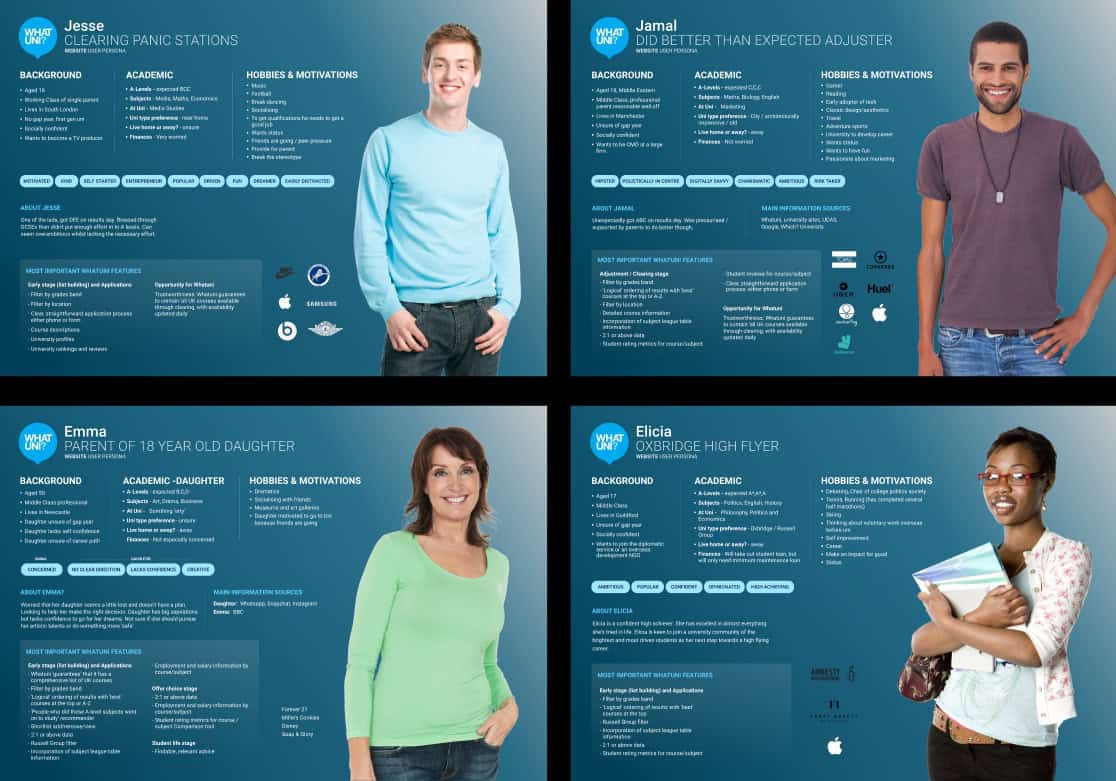
All of these things add up to a comprehensive view of each user type that can be referenced by teams when setting strategy or creating new content.
They are particularly helpful for content creators and designers to check their work against: for example, “Does this work for Kim and David?” (when Kim and David are names you’ve selected for two of your personas).
One thing we recommend is for them to be printed in large format and placed on office walls to act as reminders and prompts to help people create focused content. However, the amount of detail that’s often included in a persona can make a printout, no matter how large, look overly busy and therefore hard to take in.
With this in mind, in addition to the detailed versions, we felt that it would be useful to create highly focused “face clouds” for each persona that only displays key words and associated brands.


To a degree, just regularly seeing the face associated with a persona should be enough to keep them (and their characteristics) in mind.
But should we associate faces with personas at all? I’ll have a look at that next time.