
Author

Recently, we’ve been looking closely at how behaviour is changing in search.
One shift stands out as significant: people are increasingly turning to AI tools (like ChatGPT, Google’s AI Overviews and Perplexity) with Gartner reporting 30% of all search interactions are now happening through AI-powered assistants and generative interfaces. It’s fair to assume something similar is happening with potential clients before they open a browser tab or type a firm’s name into a search engine.

Tools like SEMRush and Scrunch now allow us to review real-world AI queries and see which websites are being cited in responses. For certain types of questions, for example “which firms handle employment disputes for technology companies in California?” or “who are the leading M&A advisers for mid-market transactions in London?”, AI is already synthesising an answer (telling the user the names of the firm – what’s usually termed “mentions”) rather than returning a list of links (or “citations”).
Your firm either features in that answer, or it doesn’t.
The difference from traditional search is significant. In a Google results page, absence is visible; you can see you’re not ranking, diagnose why, and work to fix it. When AI omits your firm from a response, there’s very little visibility of that omission without specialist tools.
Why most law firm websites weren’t built for this
When it comes to new business, law firm websites have typically been optimised for two things: impressing clients who already know roughly what they’re looking for, and ranking for keyword searches in Google. Both of those remain important but neither prepares a site for how AI systems evaluate and represent a firm’s expertise.
AI models don’t rank pages in the way search engines do. Instead, they construct answers from content they’ve already processed and sources they can retrieve. A firm’s presence in those answers depends on factors that are quite different from traditional SEO signals: whether the firm’s content clearly and directly answers the kinds of questions clients actually ask, whether the site is technically structured in a way that’s legible to AI systems, and whether the firm appears consistently and credibly across the wider web (directories, press coverage, legal databases, alumni networks and so on) not just on its own pages.
Most law firm websites, if audited against those criteria, have gaps. For example:
- Practice area pages written to demonstrate capabilities to peers rather than to answer a client’s actual question.
- Attorney bios that talk about expertise without surfacing specific representative matters that substantiate them.
- Schema markup that’s incomplete or absent.
- Directory listings that haven’t been updated recently.
None of these were necessarily problems in a world where SEO was the dominant concern (though fixing them would still have helped) but in a world where AI is increasingly the first port of call, they matter.
How to improve law firm websites for AI
The underlying question is straightforward: does your website communicate clearly and authoritatively who you are, what you do, and why you’re credible? The technical implementation follows from that; it doesn’t replace it. In one sense, it comes right back to making sure your website matches user needs – UX.
Here are three practical things worth checking your firm’s site for.
Structure that makes your expertise legible to humans AND machines. Practice area pages that clearly state the work you do, the clients you serve, and the outcomes you’ve helped achieve give AI systems something concrete to work with. A well-structured site is significantly more legible to AI than one where key information is buried in PDFs or scattered across inconsistently formatted pages.
Content that answers real questions. A lot of law firm thought leadership content is written to signal expertise rather than in the client’s language. Content that directly addresses a question — what does this regulatory change require us to do, what should we expect from this type of litigation, how do firms in our sector typically approach this issue — is more likely to surface in an AI response than analysis aimed primarily at a legal audience.
Consistency across your whole digital presence. AI models draw on what’s published about your firm across the web, not just what’s on your own site. A firm whose name, practice areas, and attorney details are consistent and current across directories, press coverage, and professional profiles is far easier for an AI to represent accurately than one with stale listings and attorneys whose bios haven’t been updated since they made partner.
US and UK: the same shift, different pressure points
The underlying dynamic is consistent across both markets, but where it’s felt most and how to tackle the visibility issue differs greatly.
In the US, the in-house legal team is a key audience likely to be using AI on behalf of their organisation. Thompson Reuters found that corporate legal teams are using generative artificial intelligence at least weekly, so General Counsel at mid-to-large corporates are likely already using AI tools to research firms, benchmark advice, and build longlists for panel reviews. If your firm’s digital presence doesn’t give AI systems enough structured, credible material to demonstrate knowledge in key areas, you might not appear on that longlist. And you won’t know you weren’t considered.
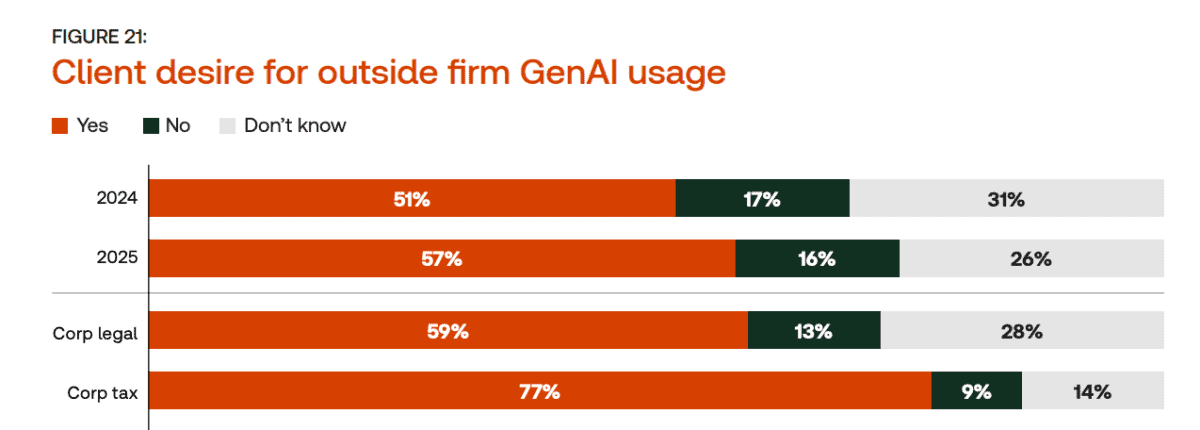
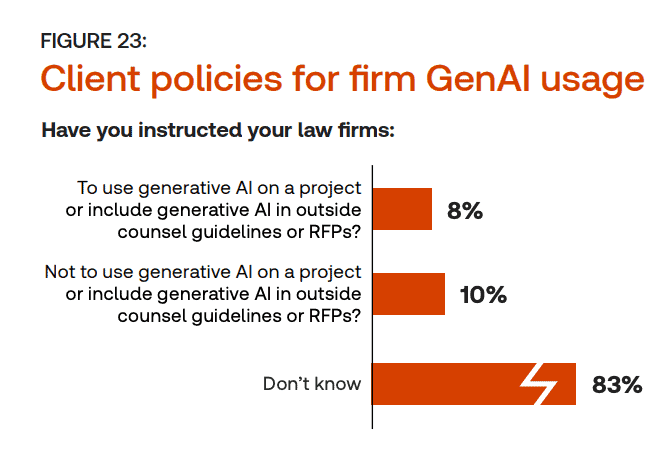
In the UK, the shift is slightly less advanced but the direction is clear. Thomson Reuters’ 2026 AI in Professional Services report found that roughly two-thirds of corporate respondents believe their outside firms should be using AI but fewer than one in five are yet specifying it in RFPs or procurement guidelines.
In the UK, there’s also a regulatory angle worth noting. The Solicitors Regulation Authority transparency requirements already push firms to publish clear, structured information on pricing and services. That content is exactly the kind of material AI systems can use to represent a firm accurately, if it’s implemented and structured correctly. Firms that have done this well for compliance reasons, perhaps inadvertently, are ahead of the curve on AI visibility. But again, if that’s not reflected elsewhere (such as on third party websites) AI may still overlook it.
What’s also clear from the Thompson Reuters data is that firms on both sides of the Atlantic are expecting more use of AI in their outside council (and that desire is increasing), but the data also shows they haven’t yet formalised that in their RFPs.
What to do about it
None of this necessarily requires a website rebuild . The most valuable changes might be structural and editorial rather than technological; auditing existing content for clarity and directness, improving the structure of practice areas and bio pages, adding question-led content sections where they’re missing, and establishing a basic discipline around keeping key information current — on your own site and across the directories and platforms where your firm appears.
What it does require is a different relationship with your website and your broader digital presence. Less a brochure that gets remade every now and then, more an ongoing editorial and technical asset.
The firms building that discipline now are accumulating a first-mover advantage that will be harder to close later.
The question isn’t whether AI search will affect your firm’s visibility anymore. Now it’s whether you’re doing anything about it.