
Author

AI can produce a convincing website concept before anyone has established whether it is right for the people who will use it. For a marketing or communications leader reviewing (or creating) the work, they need to be wary of a design that looks good but isn’t based on solid foundations.

In Why human experience still matters, Leigh explored the value of human understanding in web design. An important part of that understanding is taste: the judgement that helps a designer recognise which possibilities deserve developing, what needs changing or removing, and where to show restraint.
That judgement develops through experience. Research gives it reason and direction. Feedback helps refine it. As AI lowers the barriers to producing websites, understanding where this judgement comes from becomes increasingly important.
Generating ideas and choosing between them
The research highlighted in a recent Science Says newsletter offers a useful starting point.
In The Cybernetic Teammate, researchers studied professionals at Procter & Gamble working on product innovation challenges. When they worked with AI and a colleague, they performed 10.2% better (vs alone), and were roughly 3x more likely to be judged top performers by experts in that domain.
This research was conducted on product innovation rather than web design, but there are clear parallels between the two; it suggests the likelihood is a small team of professionals using AI outperforms both individuals and teams that aren’t making effective use of AI.
How experience develops judgement
A designer develops a repertoire through making things, discussing them and seeing what happens when people use them. Watching someone miss an important link can change how you approach hierarchy. Finding that a carefully composed layout breaks when someone enters real content can change how you plan future concepts.
Experience also gives designers a broader range of references. The value of that experience depends on opportunities to learn. Research by Daniel Kahneman and Gary Klein emphasises that reliable intuitive expertise needs a sufficiently predictable environment and opportunities to learn its patterns through feedback.
For design, the practical lesson is to keep checking judgement against use. An experienced designer can explain why a direction seems promising, recognise where that assessment is uncertain and arrange a way to test it. Taste becomes more useful or relevant when it remains open to correction and informed by experience.
Audience knowledge changes the design
Looking at an example from our own work, the Wilson Sonsini careers website illustrates how specific knowledge can change a design brief.
The most significant insight from the research we carried out was understanding that the majority (95%+) of the audience are in their twenties. We realised that a young audience would likely react well to a design focused on them – rather than a ‘standard’ corporate law look and feel – if we got it right.
Of course, we tested early ideas with people from representative target audiences, but it was our designer’s taste and experience that drove the process.
Revising a fictional careers page
To make that process visible, we used AI to produce a careers-page wireframe for a fictional law firm, Example & Co. This is an illustrative exercise, but it was an interesting test of AI given a wider brief, versus a brief taking into account the considerations a professional designer might add in. The critique drew on the Wilson Sonsini research findings, alongside professional considerations about content, accessibility and the purpose of the page.
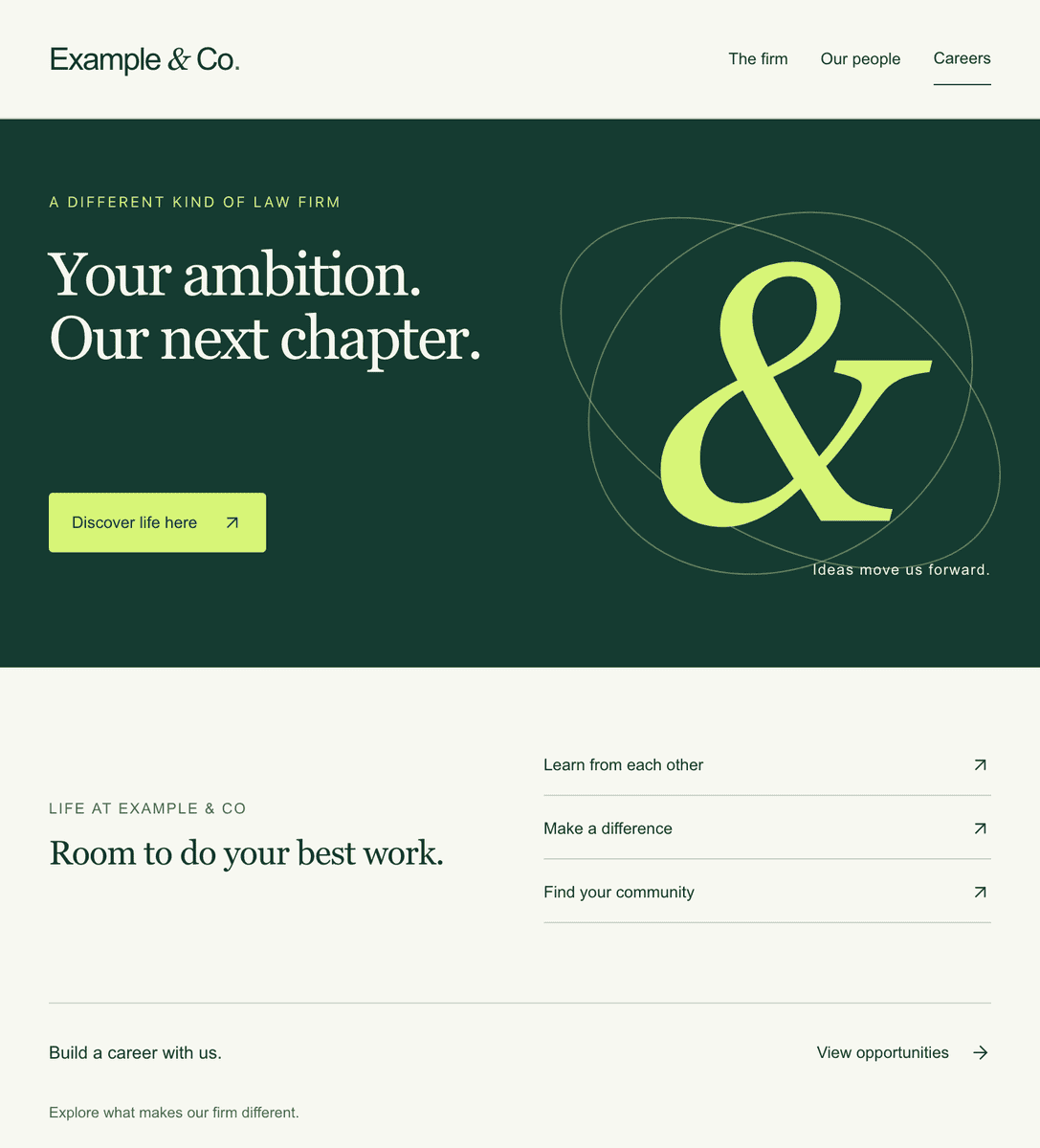
The initial concept from AI (in this case, ChatGPT) established a visual identity and introduced the firm’s culture. Its prominent headline and decorative graphic made a strong first impression, and it satisfies the fundamental requirements but also gave prospective employees little specific reason to choose this firm.
Reviewing it against prospective employee’s needs with some audience-specific design knowledge gave the revision a clearer direction:
- Make the main task prominent. Put opportunity search on the homepage, with filters for career stage, specialism and location, supported by featured vacancies.
- Create a useful connection. Introduce an alumni finder so candidates can find attorneys who attended their law school and explore a route to contact them.
- Give candidates reasons to apply. Use client highlights, specific reasons to join, careers articles and video shorts to help people understand the work and decide whether the firm suits them.
- Build accessibility into the design. Check colour contrast, label controls clearly and make the search and navigation usable across devices and input methods.
We then used AI to turn those priorities into a revised concept. Search moved forward, relevant opportunities became visible, and the supporting content acquired a purpose: helping candidates make a more informed decision about their next move.
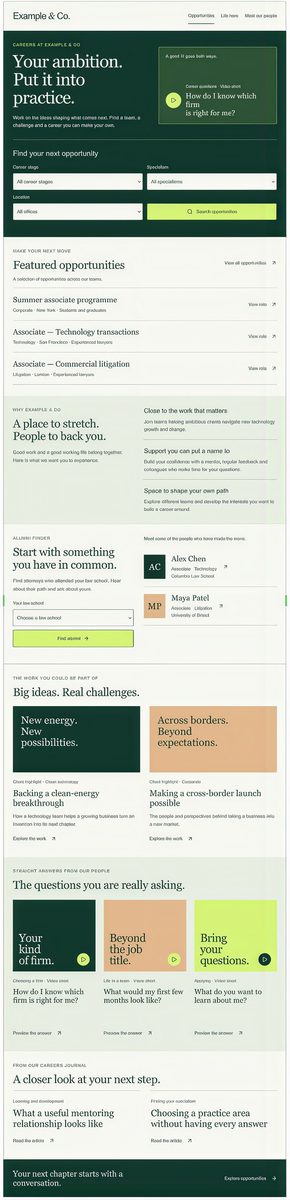
Both versions were produced with AI. The difference is the knowledge and direction brought to the review. The revision has a clearer relationship to the stated audience needs; whether it performs better in use would require further testing with prospective employees. It does include specific accessibility features that were overlooked by AI based on a prompt alone.
This is where the professional contribution becomes tangible. Experience helps identify what needs questioning, user research informs the priorities, and judgement turns them into decisions that AI can help realise. It gives the design a stronger basis than accepting the first convincing output.
Applying that judgement to design trends
The decision to introduce video shorts in our revised concept in the hero, to the right of the headline, provides another example of informed judgement. The format has a specific purpose: helping candidates understand the work, the people and whether the firm suits them. That purpose shapes the content and the hierarchy. The videos answer practical questions about choosing a firm and starting work. Opportunity search remains prominent, and comes before the lead video on mobile, so the format supports the candidate’s main task.
AI can suggest and reproduce a style. Professional judgement connects that possibility to an audience and a purpose, deciding how much emphasis it deserves and what needs testing. It also acts as a filter; humans are less likely to continue to produce the same trend over and over in the quantity AI does.
The video decision applies the same filter we used for search, content and alumni connections; the underlying research and analysis of it. That knowledge shapes the focus and direction of the design.
Giving AI a useful brief
Design judgement can start before reviewing the output. We can shape the information given to AI and the questions asked of it.
AI outputs become more useful when the prompts include the audience’s tasks, relevant research findings and the character the organisation needs to communicate. Prompts should also identify constraints and uncertainties. For example, a concern expressed by one interview participant – which may just represent personal opinion – deserves different weight from a problem observed repeatedly in testing.
AI can help explore alternatives against those requirements. A designer might investigate different ways to balance a strong visual identity with a prominent search tool, or to make a complex page feel approachable without obscuring its detail.
Experience helps frame those trade-offs. Research provides evidence for deciding between them. Testing shows where further adjustment is needed.
Combining human expertise and AI
AI gives us more possibilities to work with, and to create things more swiftly. The professional designer has a contribution too, such as:
- Accumulated experience into similar situations
- Evidence validated by research to guide decisions
- Filter against what’s important where AI can look too broadly
- Specific scoping of the work
- Responsibility for checking the result
Designers have been doing these things for years whilst also having to create everything; AI can now do some of that lifting.
Together, as we saw in the results of the P&G study, both can produce results exceeding that which they’d produce alone.